Best Solar Security Camera for Farms in India: Complete Buying Guide
A farm is often spread across a large area, and keeping an eye on every corner can be challenging.
From valuable equipment and vehicles to livestock, crops, irrigation systems and farm buildings, many things may need monitoring - especially when the farm is located away from your home or regular workplace.
Traditional CCTV systems can be difficult to install in such locations because they may require continuous electricity, network connectivity and extensive cabling.
This is where a solar security camera for farms can be useful.
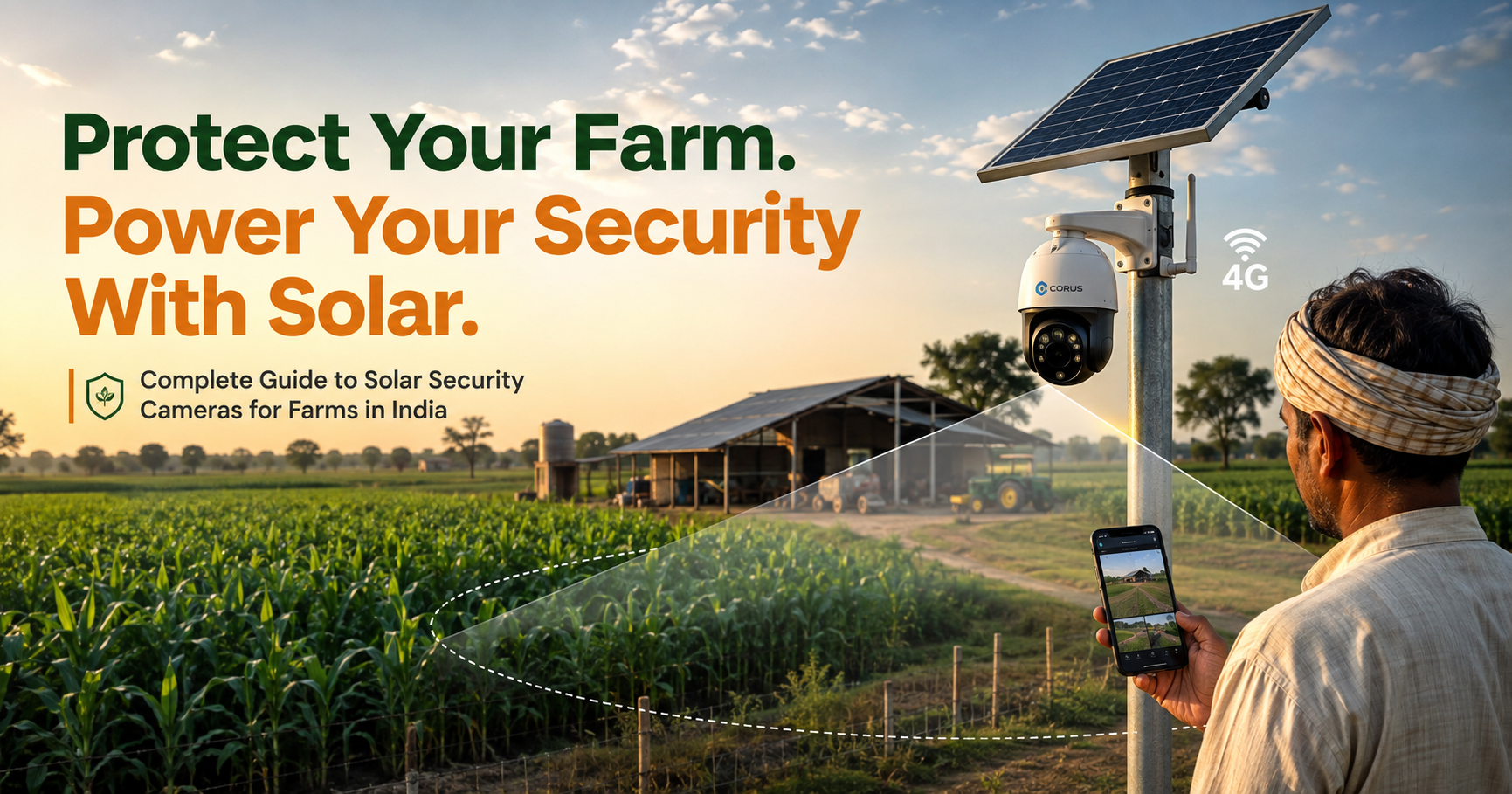
A solar-powered security camera can combine a camera, rechargeable battery and solar panel to provide surveillance in outdoor locations where running electrical cables may be difficult or expensive.
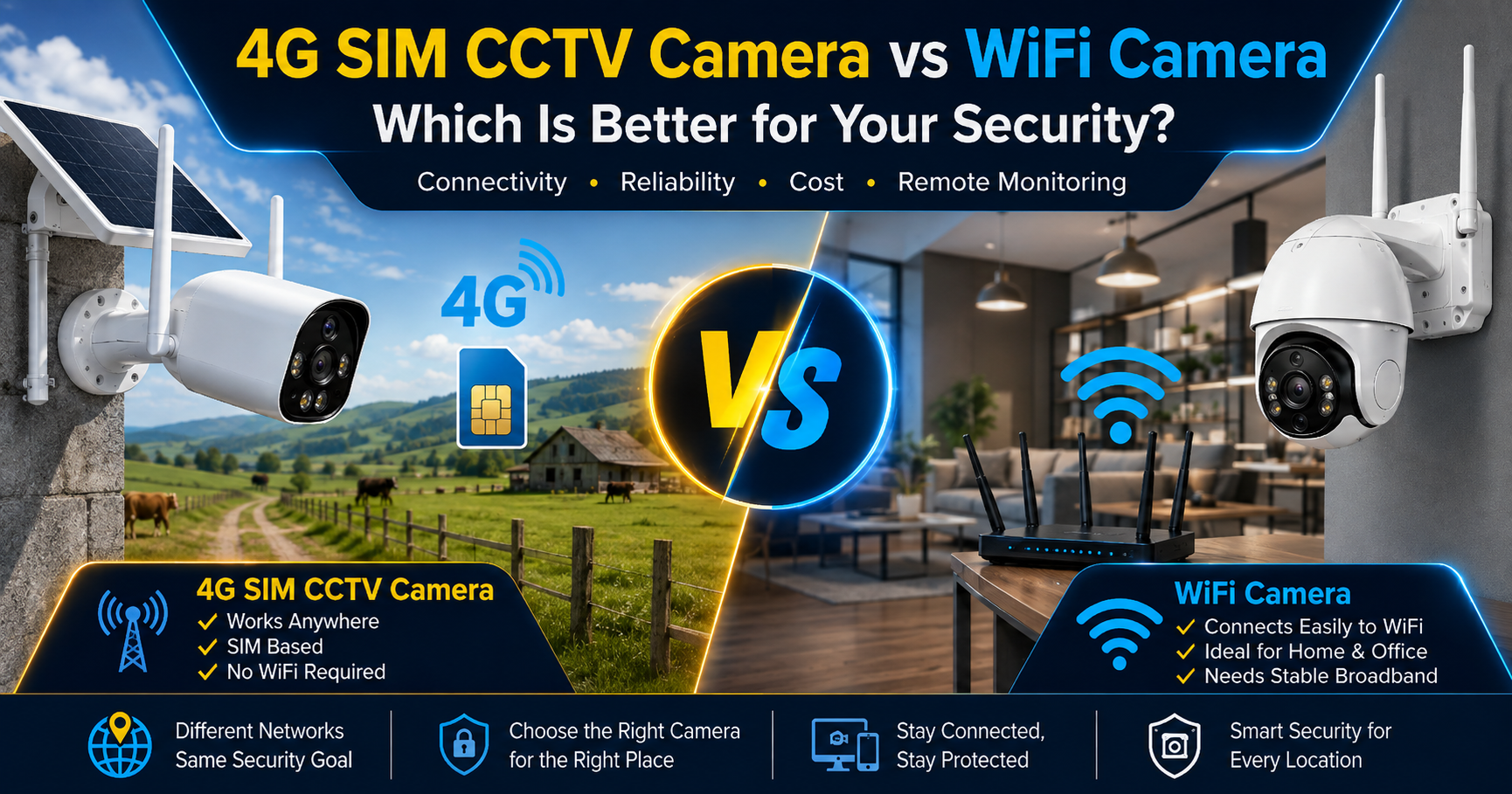
For remote locations, a 4G-enabled solar camera can provide another important advantage: connectivity through a SIM/mobile network instead of relying on a traditional Wi-Fi connection.
Solar-powered surveillance isn't limited to small private installations either. Indian infrastructure projects have specified solar panels as part of CCTV video-surveillance systems for remote monitoring.
So, if you're considering installing a solar CCTV camera for your farm, what should you actually look for?
Let's explore it.
What Is a Solar Security Camera?
A solar security camera is a surveillance camera powered primarily through a solar panel and rechargeable battery.
During daylight hours, the solar panel can generate electricity and charge the battery. The stored power can then be used by the camera when sunlight isn't available.
A typical solar security setup may include:
-
Security camera
-
Solar panel
-
Rechargeable battery
-
Mobile/4G connectivity
-
Motion detection
-
Night vision
-
Mobile application
-
Video storage
-
Outdoor/weather-resistant housing
The exact features depend on the model.
For farms and remote properties, the biggest advantage is the ability to deploy surveillance without depending entirely on a conventional wired power connection.
Why Use a Solar Security Camera on a Farm?
1. Farms Can Have Difficult Power Access
One of the biggest challenges with conventional CCTV installation is providing reliable electricity at every camera location.
A large farm may have cameras positioned far away from the main building.
Running electrical cables across long distances can make installation more complicated.
A solar-powered camera can help reduce this challenge by generating power locally.
2. Remote Monitoring
You don't necessarily need to be physically present at the farm to check what's happening.
Depending on the camera's connectivity and features, you may be able to view the camera feed through a smartphone.
This can be particularly useful for farm owners who live away from their agricultural property.
3. Useful for Large Outdoor Areas
A farm may include:
-
Agricultural fields
-
Farm entrances
-
Storage areas
-
Equipment sheds
-
Water tanks
-
Irrigation areas
-
Livestock areas
-
Parking areas
-
Farmhouses
Strategically positioned cameras can help provide visibility around important areas.
4. Reduced Dependence on Electrical Wiring
Traditional CCTV installation can involve:
Camera → Cable → Power source → Network/Recorder
A solar/4G camera can potentially simplify this to:
Solar Panel → Battery → Camera → 4G Network
This can make the solution particularly interesting for locations where conventional infrastructure is difficult to establish.
What About Farms Without Wi-Fi?
This is one of the most important considerations when choosing a farm security camera.
Many agricultural properties don't have a reliable Wi-Fi connection across the entire farm.
In that situation, a 4G SIM security camera can be worth considering.
Instead of connecting through your farm's Wi-Fi network, the camera uses a compatible SIM/mobile network to transmit data.
This can be useful for:
-
Farms
-
Agricultural land
-
Remote warehouses
-
Construction sites
-
Open plots
-
Rural properties
-
Farmhouses
-
Areas without fixed broadband
However, the camera's actual connectivity depends on mobile network coverage at the installation location.
So don't choose a 4G camera solely because it says "4G." Check the supported network bands, SIM requirements and network coverage in the area.
Solar Camera vs Traditional CCTV
|
Feature |
Solar Security Camera |
Traditional CCTV |
|
Power |
Solar + battery |
Usually electrical |
|
Cabling |
Minimal/limited depending on setup |
Often required |
|
Remote locations |
Highly suitable |
Installation can be more complex |
|
Wi-Fi dependency |
Can use 4G on supported models |
Often network dependent |
|
Installation |
Potentially simpler |
Can require more infrastructure |
|
Outdoor use |
Suitable with appropriate rating |
Suitable with appropriate rating |
|
Maintenance |
Solar panel/battery/camera |
Wiring, power and camera maintenance |
The right choice depends on the location, available electricity, network coverage, recording requirements and budget.
7 Important Features to Check Before Buying
If you're searching for the best solar security camera for your farm, don't select a camera based only on price.
Consider these factors.
1. Solar Panel Capacity
The solar panel needs to generate enough energy to support the camera and recharge its battery.
Consider:
-
Panel size
-
Charging efficiency
-
Sunlight availability
-
Installation direction
-
Seasonal conditions
-
Battery capacity
A shaded installation location may not be ideal for a solar camera.
2. Battery Capacity
The battery becomes particularly important during:
-
Night-time
-
Cloudy weather
-
Rainy periods
-
Low-sunlight conditions
Look at the manufacturer's battery specifications and understand the expected operating conditions.
Don't assume that a solar camera will operate indefinitely regardless of weather.
3. 4G Connectivity
If the farm doesn't have reliable Wi-Fi, look for a 4G-enabled security camera.
Before installation, check:
Is the mobile network signal strong enough at the camera location?
This is especially important for farms located in remote areas.
4. Night Vision
Farm surveillance shouldn't stop after sunset.
Look for cameras with appropriate night-vision capabilities.
Depending on the model, this may include:
-
Infrared night vision
-
Colour night vision
-
Low-light imaging
-
Built-in illumination
Choose based on how much visibility you need at night.
5. Motion Detection
Motion detection can help the camera identify movement and trigger recording or alerts.
This can be useful for monitoring:
-
Farm entrances
-
Equipment areas
-
Storage sheds
-
Boundary areas
-
Farmhouses
However, outdoor environments can also produce false alerts from animals, vegetation and weather conditions.
Therefore, check whether the camera provides configurable motion zones or sensitivity settings.
6. Weather Resistance
Farm cameras are installed outdoors, so environmental protection matters.
Look for an appropriate IP rating and check the manufacturer's specifications for protection against dust and water.
Also consider:
-
Heat
-
Rain
-
Dust
-
Humidity
-
Direct sunlight
This is particularly important in India's varied climate.
7. Storage Options
Check how the camera stores footage.
Possible options can include:
-
MicroSD card
-
Cloud storage
-
Network storage
-
Local recording
Understand the storage capacity and whether cloud storage involves a recurring subscription.
Where Should You Install a Solar Security Camera on a Farm?
The installation position can be just as important as the camera itself.
Recommended locations can include:
Main entrance
Monitor vehicles and people entering the property.
Farmhouse
Keep an eye on the main building and surrounding area.
Equipment storage
Useful for monitoring tractors, machinery and other valuable equipment.
Warehouse
Monitor agricultural products, tools and supplies.
Water/irrigation area
Monitor important infrastructure.
Boundary/approach road
Provide visibility around important access points.
How Many Cameras Does a Farm Need?
There is no fixed number.
It depends on:
-
Farm size
-
Property shape
-
Number of entrances
-
Buildings
-
Blind spots
-
Camera viewing angle
-
Security requirements
For example, a small farm may only need cameras at the entrance, the farmhouse, and the equipment area.
A larger agricultural property may require several strategically positioned cameras.
Instead of installing cameras everywhere, first identify the highest-risk and highest-value areas.
Is a Solar Security Camera Worth It for Indian Farms?
For the right location, it can be.
A solar security camera can be particularly useful when:
-
Electricity access is difficult
-
Running cables is expensive
-
The property is spread over a large area
-
Wi-Fi isn't available
-
Mobile network coverage is available
-
Remote monitoring is important
India's wider adoption of solar and technology-enabled agriculture also shows the growing role of solar-powered solutions in rural applications.
However, a solar camera isn't automatically the best choice for every farm.
If your farm already has reliable electricity and network infrastructure, a conventional wired CCTV system may still be appropriate.
Final Buying Checklist
Before purchasing a solar CCTV camera for your farm, ask:
Power
-
Does the location receive sufficient sunlight?
-
What is the battery capacity?
-
How does the camera perform during cloudy weather?
Connectivity
-
Is Wi-Fi available?
-
If not, does the camera support 4G?
-
Which SIM/network does it support?
-
Is mobile coverage strong at the installation point?
Camera
-
What is the resolution?
-
Does it support night vision?
-
Does it have motion detection?
-
What is the viewing angle?
Outdoor Protection
-
What is the IP rating?
-
Is it suitable for India's weather conditions?
Storage
-
Does it support SD-card recording?
-
Is cloud storage available?
-
Is there a subscription cost?
Installation
-
Where should the solar panel be positioned?
-
Will trees or buildings shade the panel?
-
Is the camera covering the required area?
Insight
A solar security camera for farms can be a practical surveillance solution when electricity, cabling or Wi-Fi infrastructure is limited.
For remote agricultural properties, combining solar power + battery backup + 4G connectivity + night vision + motion detection can provide a flexible way to monitor important areas from a distance.
But the best digital camera isn't necessarily the one with the longest feature list.
The right solution is the one that matches your farm size, location, sunlight availability, mobile network coverage and security requirements.
If you're planning surveillance for a farm, agricultural land, warehouse or other remote property, explore the available solar and 4G security camera options from CorusDigital and choose according to your site's requirements.