4G SIM CCTV Camera vs WiFi Camera: Which Is Better?
Choosing the right CCTV camera is no longer simply about image quality.
Today, homeowners and businesses also need to think about internet connectivity, remote monitoring, installation, reliability, storage, power supply and ongoing costs.
Two popular options are 4G SIM CCTV cameras and WiFi CCTV cameras.
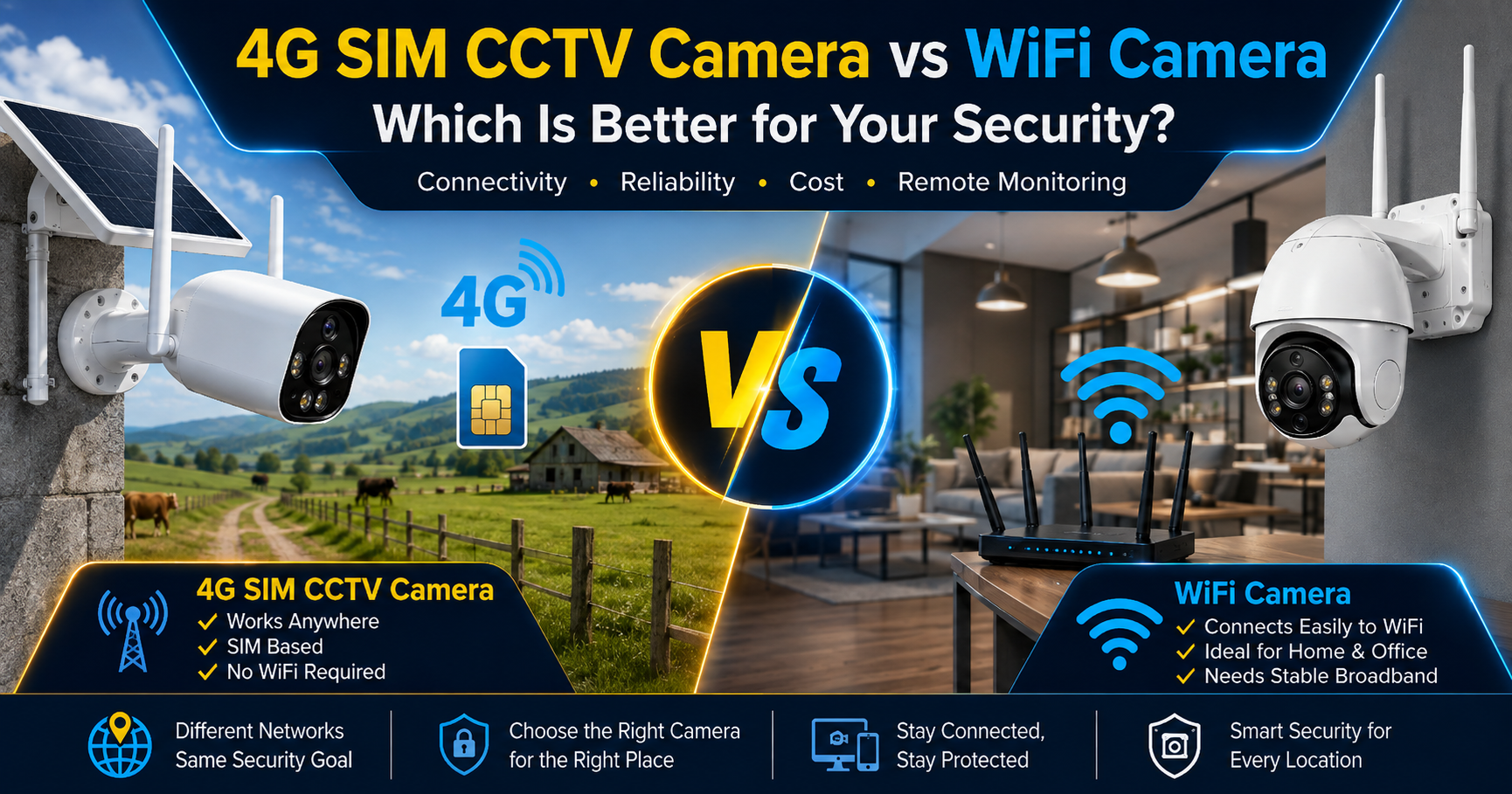
A 4G CCTV camera connects to the internet through a mobile SIM card and cellular network, while a WiFi camera normally connects to an existing wireless internet connection.
So, which one is better?
The answer depends on where you are installing the camera and how you plan to use it.
A WiFi camera can be an excellent choice for a home, office or shop that already has a stable broadband connection. A 4G SIM camera can be much more practical for farms, construction sites, parking areas, warehouses, remote properties and other locations where WiFi or fixed broadband may not be available.
Let's compare them in detail.
What Is a 4G SIM CCTV Camera?
A 4G SIM CCTV camera is a security camera that uses a 4G/LTE mobile network to connect to the internet.
Instead of connecting to your home's or business's WiFi router, the camera contains a SIM card and communicates through the mobile network.
Depending on the model, you may be able to:
-
Watch live video remotely
-
Receive motion alerts
-
Record video
-
Store footage on a memory card
-
Upload footage to cloud storage
-
Use two-way audio
-
Control the camera remotely
-
Receive notifications on a smartphone
The biggest advantage is flexibility.
If the location has reliable 4G coverage but does not have broadband or WiFi, a 4G camera may still work.
What Is a WiFi CCTV Camera?
A WiFi CCTV camera connects to the internet using a wireless network.
The camera normally needs access to a WiFi router or wireless access point.
WiFi cameras are commonly used in:
-
Homes
-
Apartments
-
Offices
-
Retail stores
-
Small businesses
-
Clinics
-
Restaurants
-
Indoor spaces
They can be relatively simple to install when a suitable WiFi network and power supply are already available.
However, the camera's connectivity depends on the quality and availability of the WiFi network.
4G CCTV Camera vs WiFi Camera: Quick Comparison
|
Feature |
4G SIM CCTV Camera |
WiFi CCTV Camera |
|
Internet connection |
Mobile 4G network |
WiFi network |
|
SIM card |
Required |
Usually not required |
|
WiFi router |
Not required |
Usually required |
|
Fixed broadband |
Not required |
Usually required |
|
Remote locations |
Excellent |
Limited |
|
Installation flexibility |
High |
Depends on WiFi coverage |
|
Internet cost |
Mobile data plan |
Broadband/WiFi plan |
|
Dependence on cellular signal |
Yes |
No |
|
Dependence on WiFi |
No |
Yes |
|
Outdoor/remote monitoring |
Strong use case |
Better where WiFi reaches |
|
Multiple cameras |
Can require careful data planning |
Usually easier on local network |
|
Farm/construction monitoring |
Often suitable |
May require additional networking |
|
Home use |
Suitable |
Often convenient |
|
Business use |
Depends on location |
Often convenient |
There is no universal winner.
The better camera is the one that matches your location and connectivity requirements.
4G vs WiFi: Connectivity
The biggest difference is how the camera gets online.
A 4G camera uses a SIM card and cellular network.
A WiFi camera uses a wireless internet connection.
For example, imagine a farm located several kilometres away from the nearest town.
There may be no fixed broadband connection at the property.
If the location has reliable mobile coverage, a 4G camera could provide remote monitoring without installing a broadband connection.
Now consider an apartment.
The property already has a broadband router and strong WiFi coverage.
In this situation, a WiFi camera may be simpler and more economical.
Which Has Better Connectivity?
It depends on the available infrastructure.
Choose 4G when mobile coverage is strong but WiFi/broadband is unavailable or impractical.
Choose WiFi when you already have stable internet and good WiFi coverage.
Installation: 4G vs WiFi
Installation is another important consideration.
A WiFi camera needs to connect to the available wireless network.
If the camera is far away from the router, you may need:
-
WiFi extenders
-
Mesh WiFi
-
Additional access points
-
Network cabling
-
A stronger router
A 4G camera doesn't need to connect to the property's WiFi network.
Insert a compatible SIM card, configure the camera and ensure there is adequate mobile coverage.
However, 4G cameras aren't completely installation-free.
You still need to consider:
-
Power supply
-
SIM compatibility
-
Mobile signal strength
-
Data plan
-
Camera mounting
-
Weather protection for outdoor installations
Internet Dependency
Both cameras depend on internet connectivity for remote features, but the type of dependency is different.
A WiFi camera depends on the WiFi network and the internet connection behind it.
A 4G camera depends on the mobile network.
This distinction becomes important when monitoring locations where traditional broadband is unreliable or unavailable.
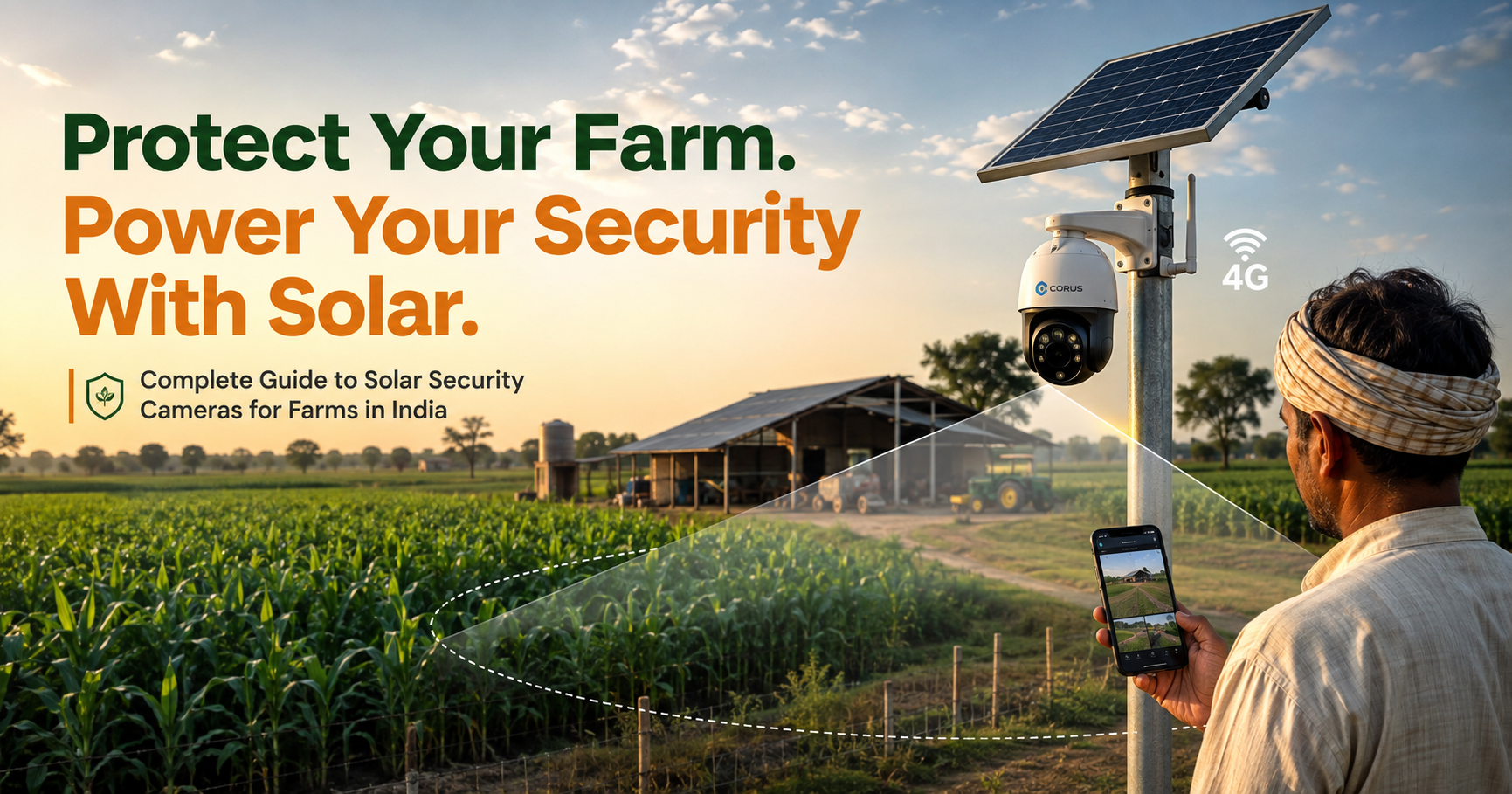
CorusDigital currently lists both 4G cameras and solar-powered camera categories, including 4G solar products.
4G Cameras for Remote Locations
This is where 4G cameras can have a significant advantage.
Consider locations such as:
-
Farms
-
Agricultural land
-
Construction sites
-
Solar installations
-
Storage yards
-
Parking areas
-
Remote warehouses
-
Rural properties
-
Temporary work sites
-
Vacation homes
Installing broadband purely to connect a CCTV camera may not be practical.
A 4G SIM camera can potentially connect directly through the mobile network.
The important condition is adequate 4G coverage at the installation location.
Before buying a 4G CCTV camera, check the mobile signal where the camera will actually be installed.
Reliability: 4G vs WiFi
Reliability depends more on network quality than on the camera label.
A WiFi camera with excellent broadband and strong WiFi coverage can be highly reliable.
A 4G camera with excellent cellular coverage can also provide dependable remote monitoring.
Problems can occur when:
-
WiFi signal is weak
-
The router frequently disconnects
-
Mobile coverage is poor
-
The camera is installed behind thick walls
-
Network congestion occurs
-
Power is interrupted
Therefore, don't simply ask:
"Is 4G better than WiFi?"
Ask:
"Which network is more reliable at my camera's installation location?"
Video Quality
4G and WiFi do not automatically determine camera image quality.
Resolution depends on the camera itself.
You can find cameras with different specifications, including:
-
HD
-
Full HD
-
2K
-
4K
When comparing cameras, look beyond connectivity.
Check:
-
Resolution
-
Night vision
-
Low-light performance
-
Field of view
-
Lens
-
HDR
-
Motion detection
-
Person detection
-
Weather resistance
-
Audio
-
Storage options
A high-quality WiFi camera can produce better images than a lower-quality 4G camera, and vice versa.
Data Usage
This is one area buyers should not overlook.
A 4G CCTV camera uses mobile data when transmitting video over the cellular network.
Data consumption can increase when:
-
Live viewing is frequent
-
Video resolution is high
-
Continuous cloud recording is enabled
-
Multiple users access the camera
-
Motion events generate frequent uploads
Before purchasing, check how the camera handles recording and data.
If the camera supports local storage through a memory card, you may be able to reduce the amount of video that needs to be continuously uploaded.
For a 4G camera, the mobile data plan should be considered part of the ongoing operating cost.
Storage Options
Depending on the camera, storage may include:
-
MicroSD/memory card
-
Cloud storage
-
Network video recorder
-
Local storage
-
Hybrid storage
A camera with local recording can be particularly useful when internet data usage needs to be controlled.
Always check the manufacturer's supported storage capacity and recording features before buying.
Power Supply
Neither 4G nor WiFi means the camera is automatically wireless in every sense.
Many cameras still require a power source.
This is particularly important for remote installations.
For a farm, construction site or remote property, you may need to consider:
-
Solar power
-
Battery backup
-
UPS
-
Weatherproof power installation
-
Backup power for the network
A 4G camera can eliminate the need for a WiFi connection, but it does not necessarily eliminate the need for electricity.
Cost Comparison
The initial camera price is only one part of the total cost.
For a WiFi setup, consider:
Camera + router/broadband + accessories + installation + storage
For a 4G setup, consider:
Camera + SIM/data plan + accessories + installation + storage
If you already have broadband and WiFi, a WiFi camera may be more economical.
If broadband installation is expensive or impossible, a 4G camera could make more sense even though it requires a mobile data plan.
Which Is Better for Home?
For most homes that already have reliable broadband and WiFi, a WiFi CCTV camera can be a convenient choice.
It can integrate easily with the existing network and avoids maintaining a separate SIM data plan for each camera.
However, a 4G camera may be useful for:
-
Holiday homes
-
Garages away from the main house
-
Outdoor areas without WiFi coverage
-
Temporary monitoring
-
Locations where broadband isn't available
Which Is Better for Shops?
For a retail shop with stable broadband and good WiFi coverage, a WiFi camera may be practical.
But consider the situation carefully.
If the shop experiences frequent broadband outages, a 4G camera could provide an alternative connectivity option.
For larger installations, however, it is worth considering a complete CCTV system rather than selecting cameras individually.
Which Is Better for Farms?
This is one of the strongest use cases for 4G CCTV cameras.
A farm may have large distances between buildings and limited broadband availability.
If there is good mobile coverage, a 4G camera can provide remote monitoring without extending WiFi across the entire property.
For farms, also consider:
-
Weatherproofing
-
Night vision
-
Solar/battery options
-
Mobile signal
-
Data consumption
-
Local storage
-
Camera placement
Which Is Better for Warehouses?
Warehouses need a slightly different approach.
If reliable broadband and network infrastructure already exist, WiFi or wired network cameras may be more appropriate.
For large facilities, the decision should consider:
-
Number of cameras
-
Network capacity
-
Recording requirements
-
Coverage area
-
Security
-
Storage
-
Backup
-
Network infrastructure
A single 4G camera may be useful for a remote entrance or separate storage yard, while the main warehouse could use a different CCTV architecture.
Which Is Better for Construction Sites?
Construction sites are another strong use case for 4G cameras.
The site may only be operational temporarily, making permanent broadband installation inconvenient.
A 4G camera can potentially provide remote monitoring while construction is underway.
This can help businesses monitor:
-
Equipment
-
Materials
-
Site entrances
-
Work areas
-
Deliveries
-
After-hours activity
Again, mobile signal and power availability need to be checked first.
When Should You Choose a 4G SIM CCTV Camera?
A 4G camera may be the better choice if:
-
There is no reliable WiFi
-
Broadband installation is difficult
-
The location is remote
-
Mobile coverage is strong
-
You need temporary surveillance
-
You need a camera at a separate location
-
You want to avoid installing a WiFi network
-
The camera is being installed at a farm, construction site or remote property
When Should You Choose a WiFi CCTV Camera?
A WiFi camera may be better if:
-
You already have reliable broadband
-
WiFi coverage is strong
-
The camera is close to the router
-
You are monitoring a home or office
-
You have several cameras on the same network
-
You want to avoid individual SIM data plans
-
Your location has weak cellular coverage
Can You Use Both?
Yes.
In some situations, using both technologies can make sense.
For example:
Main building: WiFi cameras
Remote parking area: 4G camera
Farmhouse: WiFi camera
Remote gate: 4G camera
The best CCTV system isn't necessarily based on one technology.
It should be designed around the specific areas that need monitoring.
4G SIM CCTV Camera Buying Checklist
Before buying a 4G CCTV camera, check:
-
4G/LTE network compatibility
-
Supported SIM/network bands
-
Mobile signal strength
-
Data requirements
-
Camera resolution
-
Night vision
-
Motion detection
-
Person/vehicle detection if required
-
Local storage support
-
Cloud storage options
-
Mobile application
-
Two-way audio
-
Outdoor weather resistance
-
Power requirements
-
Solar/battery compatibility
-
Manufacturer support
-
Warranty
For WiFi cameras, also check:
-
WiFi frequency compatibility
-
Router range
-
Signal strength
-
Internet speed
-
App compatibility
-
Cloud subscription
-
Local storage
-
Security features
Frequently Asked Questions
Is a 4G CCTV camera better than a WiFi camera?
Not necessarily. A 4G camera is better when cellular connectivity is more practical than WiFi. A WiFi camera is often more convenient when reliable broadband and WiFi are already available.
Can a CCTV camera work without WiFi?
Yes. A 4G SIM CCTV camera can connect through a mobile network instead of WiFi.
Does a 4G CCTV camera need a SIM card?
Yes, cellular-connected models generally require a compatible SIM and an appropriate mobile data plan.
Does a 4G CCTV camera use mobile data?
Yes. Remote live viewing, cloud recording and video transmission can consume mobile data.
Can I use a 4G camera in a rural area?
Potentially, provided there is sufficient compatible mobile network coverage at the camera's location.
Is WiFi CCTV cheaper than 4G CCTV?
It depends on your existing infrastructure. If you already have broadband and WiFi, WiFi may have lower ongoing connectivity costs. If broadband installation is difficult, 4G may be more practical overall.
Can a 4G CCTV camera record without internet?
Some models can record locally to a memory card even when internet connectivity is unavailable. However, features such as remote live viewing and cloud uploads generally require connectivity.
Which camera is better for a farm?
A 4G CCTV camera can be a strong option for farms when reliable mobile coverage is available but WiFi or broadband isn't practical.
Final Verdict: 4G SIM CCTV Camera vs WiFi Camera
There is no single winner.
The right choice depends on where the camera will be installed and what connectivity is available.
Choose a 4G SIM CCTV camera when you need surveillance in a remote location, temporary site, farm, construction area, parking space or property without reliable WiFi.
Choose a WiFi CCTV camera when you already have stable broadband and strong WiFi coverage at the location.
The most important question isn't:
"Which camera is better?"
It's:
"Which connectivity option will remain reliable at my camera's location?"
Check the network first, then compare camera features, storage, power requirements, data costs and long-term reliability.
That approach will help you choose a CCTV camera that fits your actual security needs rather than simply choosing the newest technology.